Finding the Alexander Art Trail requires noodling through the back of beyond, but this unique—in the truest sense of the word—sculpture park sited amidst down east Maine’s lakes and woods makes the effort worthwhile.
Once you find it, douse yourself with bug dope and follow the trail. First stop: the donation box, $2 pp is requested. Trust me, it’s worth it. The trail moseys through woodlands peppered with imported, life-size, hand-carved, oak sculptures. It’s labeled as the largest hand-carved outdoor sculpture collection in Maine, and the only somewhat similar one I’m aware of is the equally quirky Langlais sculpture preserve in Cushing (more on that in a future post).
The (late) Roland and Grazina Paegle created the sculpture park after seeing similar ones in Europe. They hired Lithuanian artists to hand carve the life-size sculptures in solid oak, choosing ones that complemented the lakes and woods setting.
On this side of the Atlantic, the Paegles began cutting the trails on land near the shores of Barrows Lake at the base of Breakneck Mountain. They made cases to shelter smaller pieces, and began soliciting local artists to participate. The trail, a collaboration between a local landowner, the non-profit History Dome and Art Park, Inc., artists, and volunteers, had its first full season in 2010.
According to the Alexander Sculpture Trail’s website, the park is “part museum, part gallery, and part fairy woodland.” It’s an accurate description. More than two dozen sculptures pepper the woodlands. Most are smack on the trail, but those who look a bit beyond into the woods will find some surprises.
In addition driftwood sculptures created by Roland Paegle and pieces loaned or created by other artists complement the Lithuanian carvings.
Sculptures aren’t identified, leaving visitors to imagine who or what they are and the relationship between adjacent sculptures. For example, I easily spied Little Red Riding Hood and the Big Bad Wolf; another sculpture that must have been one of Snow White’s dwarfs; and one that looked like a Viking fisherman or maybe it represented a spiritual loaves-and-fishes inspiration.
Paegle’s driftwood works are intriguing. Some show a sense of humor. Both American Idol and Bad Hair Day made me chuckle. Another asked: Is your glass half full or half empty?
The longer I stayed, the more I saw. Sure, you can tour through the sculpture park in 20-30 minutes, but if you pause here and there, stop to carefully examine the works in cases, and aim to spy the surprises, it’s easy to while away an hour or so here. Carved benches and seats make it easy to relax and enjoy the experience.
Since the park defines remote, it’s wise to allow enough time to enjoy it, ponder interpretations, and find the surprises when planning a trip.
The Alexander Art Trail sculpture park is in Alexander, Maine, about 30 minutes west of Calais. From Route 9, turn south on Davis Rd., just west of the South Princeton Road, and follow the signs — you’ll need to look carefully, as some are partially screened by foliage. Turn right on Crawford Road (at the Pleasant Lake Camping Area), then keep left on Barrows Lake Road. At the T intersection, turn right. You’ll see the sculpture park on your left just before the waters of Barrows Lake appear on your right.
Note: When you’re getting close, roads will change to dirt. Honestly, you’ll likely think you’re lost before you find it, but persevere.
From the minute one arrives at Maine’s Spruce Point Inn, there’s a sense of ahhhh. The oceanfront resort sprawls over 57 landscaped acres salted with numerous amenities, including pools, hot tubs, spa, games and fitness rooms, outdoor activities, and dining options.
Despite all the temptations, it’s hard to resist just settling into one of the Adirondack chairs placed on the lawn and along the shore and simply soaking in the water views.
Frankly, there’s no reason to even leave the resort’s property, other than to see or experience nearby attractions, and boat and van shuttles make even that, easy to do.
The inn’s accommodations include rooms and suites in the main inn and lodges as well cottages and townhomes. I checked into my split-level Lodge room, entering via a private covered, oceanview porch with two of those irresistible Adirondack-style chairs. From here, French doors opened to a comfy sitting area with a pullout-couch, easy chairs, large flat-screen TV, and gas fireplace. That gave way via two steps to the bedroom area, with two queens dressed in triple-sheeted white bedding.
Another set of French doors, these frosted, opened to the bathroom, with oversized, jetted tub, separate shower, and dual vanity. Vaulted ceilings and the open concept, along with the Maine cottage-style décor, enhanced the suite’s spacious feeling.
In-room amenities included nice robes, a Keurig coffee-maker, a refrigerator with Poland Spring water, and a microwave. Seriously, I could have easily camped out here for the week, but with so many tantalizing options, I set out to explore.
Head to the Spruce Point Inn’s waterfront for kayaks, paddleboards, bicycles, the saltwater pool, fishing equipment, charter sails, and the shuttle boat to Boothbay Harbor.@Hilary Nangle
I planned to check out the waterfront offerings, but en route, one of those Adirondack chairs by the shoreline called my name. For a good 20 minutes or so, I watched the boat traffic in and out of the harbor, kids swimming in the ocean, and kayakers paddling along the shoreline.
Eventually, I broke away and headed to the oceanfront saltwater pool, where a number of families looked settled in for the day. Adults soaked in the hot tub while the kiddos played in the pool or the ocean waters, racing each other to a float.
An attendant takes care of needs and also oversees the sporting equipment: fishing rods, kayaks, paddleboards, and bicycles in kid and adult sizes. From the dock, a shuttle boat ferries guests to downtown Bar Harbor on a set schedule. As I turned to mosey inland, I noticed a massage tent set up on the shore; nice!
Paths lace the grounds, with signposts pointing to various facilities. En route to the freshwater pool and spa, I walked by the main inn, the chef’s garden, and an outdoor fire pit with an adjacent oversized chess/checkers set up.
This route also took me by a few of the individual cottages scattered around the property, the games-filled Lighthouse recreation hall (with complimentary guest laundry), a playground complete with a sailboat and a lobsterboat, and lawn games area. Just beyond the heated freshwater pool and the spa were two Har-Tru tennis courts. In addition, two miles of hiking trails lace the woodlands.
Here’s the real plus: Use of all these amenities is included in the rate. While spa services (massages, etc.) incur fees, all guests have access to the spa garden area, with hot tub. Charges also apply for boat charters.
The weather was ideal during my stay, but what if it rains? That’s when the rec hall, fitness room, and spa all come in handy.
Where to begin… The Spruce Point Inn offers a slew of set activities, all included in the rate. These include a culinary demo and tasting, mixology class, evening s’mores at the fire pit, fairy houses, and harbor tours to Burnt Island Light.
Also included are children’s programs for ages 5-12, by reservation on a first-come, first-served basis. The Lighthouse Camp runs Thursday through Sundays from 10am-2pm and includes lunch and a snack. Kids’ Night Out includes dinner and a snack and keeps kids occupied on Thursday, Friday, and Saturday evenings from 6-9pm, so parents can enjoy a quiet dinner.
Meals aren’t included in the Spruce Point Inn’s rates, but there are several options, restaurants in the Boothbays run the gamut from fast food to upscale dining. Of course, most of the ingredients are sourced locally.
Bogie’s is a casual spot with two dining rooms and a bar/lounge. Breakfast is a self-serve buffet with a breads and pastries station, omelet station, fruit and cereal, and hot entrees. Beverages are served to the table.
Lunch is available on an expansive, ocean-view deck.
Bogie’s can get very busy especially for dinner, when reservations are advised. The broad menu has something for everyone, including shared items, light bites, and entreés, with an emphasis on comfort foods; think fancy burgers and lobster rolls to lobster mac ‘n’ cheese and seafood paella ($12-24). I dined with a friend and opted for a high-top table in the bar area, where service was friendly and efficient; loved the beer mussels, SPI signature salad, and the paella.
While most guests keep it easy and casual at Bogie’s, the inn also offers fine dining in 88, a white tablecloth venue welcoming those age 10 and older; entrées such as lobster en papiolotte, seared filet mignon, and a vegetarian fresh linguini run $20-35. Guests are expected to dress appropriately (jackets encouraged but not required for men; no jeans, sneakers, or sportwear).
The Spruce Point Inn offers a number of dog-friendly accommodations, and I saw a lot of dogs during my stay. There’s no extra fee, which makes sense, since this is an especially family friendly resort. A lot of multi-generation families are frequent guests, and dogs are part of the family.
It’s easy to while away the day relaxing by the ocean-side infinity pool and hot tub at the Inn at Ocean’s Edge in Lincolnville, Maine. Courtesy photo.
The splurge-worthy Inn at Ocean’s Edge delivers on its name. Tucked well off Route 1 in Lincolnville, this Maine inn’s seven-acre property descends to a pebble beach. On clear days, ocean views take in ferry-linked Islesboro; on inclement ones, fog often shrouds the island, creating mystical, but equally beautiful views.
Foggy and damp were the conditions when I visited earlier this month as part of my research for a new edition of one of my Moon-series Maine guidebooks. Sited off Route 1 in Lincolnville, the inn is about 3 miles north of Camden and just over a mile south of Lincolnville Beach. A quiet lane descends through woodlands before arriving at the Inn at Ocean’s Edge.
The Inn at Ocean’s Edge comprises two shingle-style buildings: one waterfront, with guestrooms, breakfast room, lounge, fitness room, and pub; and another sited above it, with more guestrooms. I stayed in the main building, where most guestrooms, including mine, face the water. Guests in the Hilltop building have panoramic water views from private balconies.
Upon entering my room, what struck me first was the spaciousness. The handsome decor—an elegant and minimalist palette in muted shades of pewter, slate, and cream—enhanced that.
Every room has a gas fireplace, a wet bar with refrigerator, a desk, individual temperature controls, and a seating area with two comfy chairs with table and an ottoman. I loved that with the window open, I could hear waves lapping the shore.
Granite countertops and oversized showers highlight the bathrooms. Some rooms also have jetted tubs. Bathrobes are provided, always a nice touch.
It would have been easy to while away the damp afternoon by watching the fog swirl and fireplace flames dance. Instead, I donned a raincoat went exploring. First stop, a small seating area on the second floor with a balcony over the first-floor breakfast room, which opened to a deck. When I padded downstairs, I found afternoon sweets laid out next to the all-day coffee and tea.
On the main inn’s lowest level is a fitness room with aerobic machines, free weights, and other fitness equipment. Also here is an especially large library/lounge, with couches grouped by the fireplace, shelves filled with books, easy chairs, a table perfect for bridge or other games, a big-screen TV, and a guest computer with printer.
The library/games room offers direct access to a landscaped yard, salted with organic gardens, shade trees, and lounge chairs. Pebble paths connect to the shoreline and to the separate Poolhouse building, built into the hillside.
The Poolhouse Suites have views over the pool and hot tub to the ocean. Courtesy photo
I toured one of the two, cathedral-ceiling Poolhouse Studio Suites that occupy the upper level. Thanks to that hillside siting, both have direct access from the path. Each suite comprises two areas decorated in Maine cottage style.
The entry area offers a kitchenette with refrigerator and microwave, a bathroom, and an oversized closet. A door opens to the an oversized king bedroom with comfy chairs in front of the fireplace; a TV is over the fireplace, and adjacent to the fireplace is a large jetted tub. A private, covered balcony overlooks the pool to the ocean.
Directly below the suites in the Poolhouse is another guest social room with inviting seating and a fireplace along with self-serve honor bar stocked with wine, beer, and soft drinks. A peek down a hallway revealed a wood-burning sauna and two massage rooms.
The social room opens to an outdoor lounge, with vanishing-edge pool, hot tub, lounge chairs, and a fireplace. Towels are provided, and there are changing rooms, too. If it had been a nice day, it would have been hard to get me away from here.
The Inn at Ocean’s Edge serves a full breakfast. This includes buffet areas with pastries, fresh fruit, smoked salmon, juices, and cereals, as well as a hot entrée served to the table; choose from eggs any style, pancakes, or the daily special. I opted for the latter, a delicious frittata. Guests may dine in the dining room or outside on the water-side deck.
Those who plan ahead can order a box lunch, but the order must be placed by 8pm the previous day.
Also on the main floor is a bright pub with a full bar. Grab a seat at the bar, one of the tables, or relax by the fireplace.
View of the Inn at Ocean’s Edge from the water side. The oceanfront inn’s 7-acre property includes woodlands, shady lawn, and organic gardens. @Hilary Nangle
When it comes to location, few Maine hotels can rival that of the Black Point Inn. Built in 1878 at the tip of Scarborough’s Prouts Neck, the shingle-style inn tops a rise between Ferry Beach and Scarborough a.k.a. Jordan’s) Beach. Coastal views extend south to Old Orchard, north toward Casco Bay, and out to open ocean. Just a short walk or pedal away is the carefully restored Winslow Homer Studio (now owned by the Portland Museum of Art), where the artist painted many of his masterpieces. Tucked in between is a woodland sanctuary laced with trails and boardwalks.
I have history with the Black Point Inn, so please indulge me in a bit of reminiscing. My best job ever was here one summer during my college years. I was hired as a dining room waitress, but the hotel needed someone to serve drinks. I was of age, so I was given the job.
Now this was when the BPI was a classic, old-style summer resort owned by the Dugas family. Most of the staff worked in Florida during the winter, and Maine in the summer, and every job had its social place. As a cocktail waitress, I was considered upper staff. That meant I didn’t stay in the dorm, but had a private room in the same building as the executive and sous chefs; it also meant that I didn’t eat in the zoo mess, but in the side hall dining room, served by a waitress and dining off the guest menu with only the lobster and steak crossed out.
The genteel clientele comprised the newly wed and the nearly dead. Of the latter, many came for the summer, sitting in the exact same chair at the exact same table, ordering the exact same drink every day (Mrs. Robinson, small window table facing water, Crown Royal on the rocks).
I served drinks around the ocean-side pool at lunch, in the lounge in the afternoon, and in the formal dining room (jackets for men) during dinner service. That left plenty of time to hit the beach during the day, and at night—remember newly wed/nearly dead—the lounge usually closed by 10 or so, leaving plenty of time to catch last call in Portland.
In the years since, the resort has had its ups and downs. The ocean-view pool where lunch was served is now a private home (a newer, geothermically heated outdoor pool is behind the inn); the dorm and staff cottages are gone; conference space added and taken down; the public space on the first floor reworked. Now, under management of the Migis Hotel Group, the Black Point Inn is again flourishing as a classic summer hotel with luxurious touches, but without stuffiness.
The first thing I spied upon approaching the inn was an inviting line of white, Adirondack-style chairs on lawn, positioned just so to take in the sunset views over Ferry Beach. On a clear day, you can even see Mount Washington’s distant outline as the backdrop.
Also positioned to take in those views are an ultra-spacious sun porch with inviting wicker furniture and games tables; an open porch with dining tables and more wicker lounging chairs; an indoor dining area and lounge; and the inn’s living room, with seating areas grouped around a grand piano and a fireplace. One signature of the Migis Group (owner of Migis Lodge on Sebago Lake) is that there’s always a wood-burning fire blazing, no matter what the temperature.
I arrived in time for afternoon refreshments, so I helped myself to a cup of Harney tea (big points in my book; hard to beat Harney for bagged tea) and a couple of cookies, while my bag was delivered to my room. I could have asked for someone to take me in the original, historical operator-required elevator, but I opted for the stairs.
Upon check-in I was told there was a wine-tasting starting that afternoon (other days offer beer tastings and live jazz), and I wasn’t about to miss that. I found a rep from Devenish Wines pouring various whites and reds on the porch. Complimentary cheese and crackers were also provided. I settled into a wicker rocker with a glass of Sancerre and a small plate of nibbles, and gazed out at the easy-on-the-eyes views.
I loved my spacious third-floor room with views northward along the coast. It had a nice sitting area, and a newly redone bathroom with dual sinks and large tiled shower. The rooms have air-conditioning, but I opted to open windows and let the sea breezes do the work instead.
Guests are provided with complimentary Wifi, bottles of Poland Spring Water, and nice bathrobes. The latter are handy when heading to the pool. A hefty book listed about everything you could consider, from activities and experiences to optional services, such as laundry.
I peeked into a few other guestrooms. Some are ideal for families, others for gal-pal trips, connecting rooms are an option. None of the 25 rooms or suites is alike. A few have private decks or big bay windows. I think most have water views.
The Black Point Inn is also a Maine certified-green Environmental Leader. Among its green initiatives: refillable shampoo and conditioner dispensers, water-conserving faucets and showerheads, composting kitchen food waste, geothermic heating and cooling system, and culinary partnership with the Gulf of Maine Research Institute to support responsible harvesting of Gulf of Maine seafood.
A friend met me for dinner. We had reservations for The Point, the inn’s more formal, white-tablecloth dining room, but it was such a perfect evening, we switched to The Chart Room, so we could dine at an outside table. My oven-roasted cod (with Laughing Bird shrimp, fregula sarda, and lemon-butter sauce) was moist and flavorful—and I’m fussy about fish; my friend’s lobster roll had her smiling. For dessert, we split a confit lemon honey tart. Neither of us planned to eat ore than a bite or two, but it disappeared and we each wished we’d ordered our own.
After dinner, I climbed the steep, narrow, winding stairs to the inn’s Widow’s Walk, accessed from the third floor, to catch sunset’s lingering smokey light.
The next morning, hearty Maine gal that I am, I enjoyed my traditional eggs benie breakfast outside as well.
Note: The restaurant is open to the public, and early and late in the season, the inn often runs two-for-one specials with coupons in the local papers.
The Black Point Inn’s location is primo. For starters, there are the two beaches: quiet Ferry Beach, with usually gentle surf, and Scarborough Beach, with crashing waves.
Now add the Cliff Walk, a rugged, 150+-year-old coastal ramble that soars over cliffs and drops to rocky beaches, and passes the Winslow Homer Studio. Anyone familiar with the artist’s works likely will recognize scenes along the Cliff Walk from his paintings. For art lovers, the inn’s Winslow Homer Studio Tour package is a must.
For easier walking, opt instead for the woodland bird sanctuary, a gift to the people of Prouts Neck from Charles Savage Homer, Winslow’s brother. I loved moseying here. You might find a map at a trail head. In any case, look for the Homer memorial.
If I’d wanted, I could have borrowed one of the inn’s beach bikes for an easy pedal; a real plus for cyclists—the neck’s 25 mph speed limit is strictly enforced. Also available to guests are paddleboards, kayaks, and canoes—nice for exploring from Ferry Beach in to the Scarborough Marsh tidal estuary.
Other perks include access to the private Prouts Neck Beach Club and, for a fee, to a private ocean-side golf course and 14 private clay tennis courts.
Truth is, while there’s much to explore in the area, you could easily enjoy a classic late 19th-century-style vacation spending your days in the pool, on the beaches, hiking, paddling, or exploring a woodland, claiming the same table every evening, and never leaving Prouts Neck.
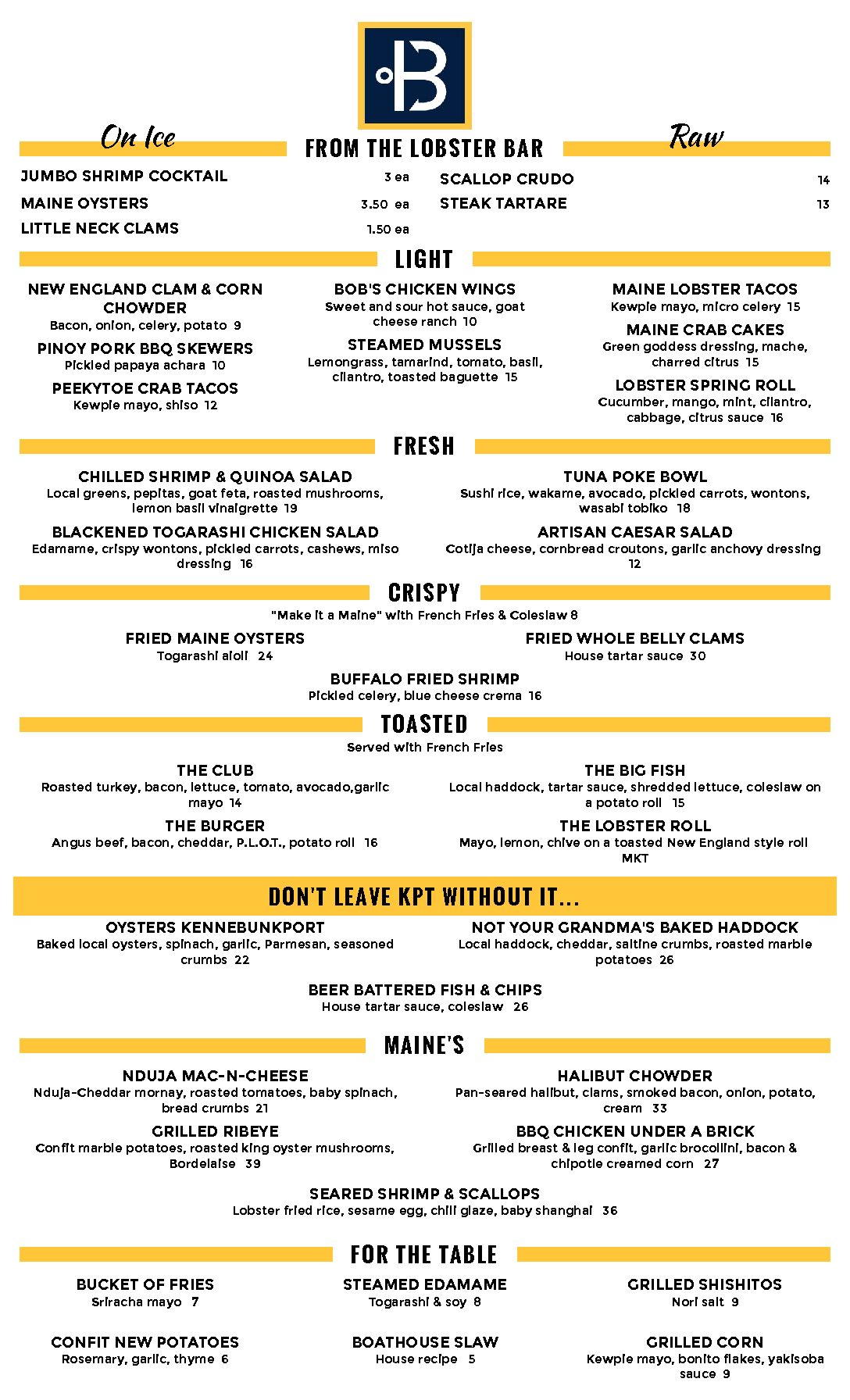
Diners at The Boathouse Restaurant, just off Dock Square, have great views of the Kennebunk River from inside as well as from on the large deck. Courtesy photoMenu for The Boathouse Restaurant in Kennebunkport, Maine.
Classical Maine fare gets an update on Chef John Shaw’s menu at The Boathouse Restaurant, in Kennebunkport. The restaurant, part of the Kennebunkport Resort Collection, is sited in The Boathouse Hotel. The site was last occupied by Davids KPT, which closed in late October.
Updates to the restaurant’s design include the addition of The Lobster Bar, which serves chilled Maine lobster tail, Maine lobster tacos, Maine oysters, scallop crudo, and similar fresh seafood.
Chef Shaw, a Kennebunk native, spent seven years in the kitchen at The Tides Beach Club, a KRC property on Goose Rocks Beach. His menu emphasizes fresh Maine seafood and other locally sourced ingredients, often with Asian accents.
The Boathouse Restaurant, open daily, noon-9pm for lunch and dinner, has seating indoors as well as on a large deck hanging over the Kennebunk River.
Tick- mosquito- and other insect-repelling clothing comes in kid and adult sizes. Photo courtesy Dog Be Gone.
Beat bugs with Dog Not Gone Maine-made, No Fly Zone, insect-repelling clothing and accessories for people, dogs, and horses. Designer Julie Swain uses permethin-treated fabrics that repel ticks and biting insects including mosquitoes, chiggers, ants, flies, and midges. I’ve tested the vest, and can highly recommend it.
Not only are biting insects annoying (itching, scratching!), but increasingly they also carry diseases such as Lyme and Zika. Better safe than sorry—even preventive treatment for tick bites can exceed $200, which makes insect-repelling clothing a smart buy.
I’d all but sworn off walking in the woods, until Julie introduced me to her product line. My hunter-orange vest not only repelled the nasties, it also kept me highly visible both in the woods and when walking along roadways.
Ways to beat bugs
Keep kids safe with insect-repelling clothing made in Maine. Photo courtesy Dog Be Gone.
After you outfit yourself and your family, think about outfitting your dog and/or horse with pet-specific insect-repelling and/or visibility products. Check out the No Fly Zone insect-repelling safety vests and kerchiefs for dogs; No Fly Zone safety horse vests; untreated safety vests and pack vests for dogs; and a safety leash, reflective safety collar, and high-visibility reflective collar kerchief.
Swain, and her husband, Bill, founded Dog Not Gone in 2005. Her first product was a vest for a hunting dog, which she made at home. A buyer from L.L. Bean saw it, and the company took off. Now, their visibility and insect-repelling clothing and accessories are made in Skowhegan, Maine, using cloth that’s made in America.
If you’re in Skowhegan, visit the factory outlet store at 40 Dane Lane; check the website for current hours.
NOTE: I’m recommending this product because I tested it. I have not received any monetary or sponsorship compensation.
The Groton Inn, rebuilt after a 2011 fire, opened May 3, 2018, in Groton, Mass. courtesy photo
GROTON, Mass..—Once America’s oldest inn, The Groton Inn is the newest addition to the Migis Hotel Group. The original hotel, dating from around 1678, was destroyed by fire in 2011.
History begins anew for The Groton Hotel
Rebuilt as a 60-room boutique hotel, it takes its cues from classic New England architecture and colonial history. Of course there’s a working fireplace—a roaring fire is a Migis signature that began with its Migis Lodge property on Maine’s Sebago Lake. Other period details include hand-hewn hickory floors and brass fixtures.
History yields to comfort in the guestrooms. Amenities include bathrobes, Wifi, a fitness center, landscaped courtyard with fireplace, and the Forge & Vine restaurant, slated to open this summer on the shared 8.5-acre property. In keeping with the hotel’s theme, the menu will offer seasonally inspired, contemporary New England fare.
The Groton Inn is open year round. Rates start at $169/night including a full buffet breakfast.
About the Migis Group
Other properties managed by Migis Hotel Group include Migis Lodge on Sebago Lake, Maine; Black Point Inn on Prouts Neck, Maine; The Inn at Ocean’s Edge, Lincolnville, Maine; The Sparhawk Oceanfront Resort, Ogunquit, Maine; 250 Main, Rockland, Maine; The Emerson Inn, Rockport, Massachusetts; Higgins Beach Inn, Scarborough, Maine; and Hotel Domestique, Travelers Rest, South Carolina
The family owned Meadowmere Resort puts the best of Ogunquit within footsteps. That’s not the only reason to stay here. The Meadowmere’s facilities make it as enticing for a family vacation as for a romantic escape. Not many accommodations can pull that off, but it does, and does so quite well.
The Meadowmere sold out of family ownership so expect different experience than mine.
Another plus: The resort is especially green. It was Ogunquit’s’s first certified eco-friendly green hotel. Among its programs: ozone laundry system, solar hot-water system, and 100-percent environmentally friendly cleaning products. Learn more about the resort’s green policies, here.
The resort is sited on Route 1, between Obeds Lane and Bourne Lane, about two blocks from Shore Road. The location allows you to park your car and forget it; no need to deal with permits or traffic congestion. From here, it’s an easy walk 5- to 20-minute to Ogunquit’s restaurants and shops, the Ogunquit Playhouse, Perkins Cove, the beach, and the Marginal Way cliff-hugging footpath. Even better for families heading to the beach: The hotel offers wagons for toting beach gear. Don’t want to walk? Catch the seasonal trolley that connects with other trolley routes from York to Old Orchard Beach.
Another location plus: Jonathan’s Restaurant is next door. Go for dinner or better yet, dinner and a show in the intimate upstairs theater.
Accommodations are spread among five buildings on a nicely landscaped campus. Room categories include resort rooms, various luxury suites, honeymoon suites, family suites, and, of course, ADA rooms. I’ve experienced two different accommodations: a luxury fireplace suite in the West Meadow building, and a Resort Room in the East Meadow building.
The luxury fireplace suite was, of course, more spacious and included a nice sitting area as well as a balcony overlooking the outdoor pool. The Resort Room, was perfect to share with a friend and it also had a small balcony. Both rooms had large TVs, individual temperature control, Wifi, and a refrigerator.
The Meadowmere’s campus offers a full range of resort amenities, and it doesn’t charge those ridiculous resort fees. Enjoy indoor and outdoor pools, an outdoor hot tub, an indoor Roman spa, a barbecue area, nicely tended gardens, a well-equipped fitness club, sauna and steam rooms, massage rooms, a theater-style TV room, a games room/arcade, a library, and more. In short, even when the resort is fully booked, you usually can slip away to a quiet spot, either inside or outdoors.
The Meadowmere’s West Meadow Pub, with a fireplace, TVs, and full bar, is open year round. I popped in with a friend for a glass of wine, and found it quite comfy. During summer season, a complimentary continental breakfast buffet is offered every morning. There’s also a full menu for lunch and dinner. Year round, it’s open late afternoon and evenings, offering drinks and a light menu. There’s live entertainment in the pub most weekends.
What to know: The Meadowmere Resort is open year round. It is not pet friendly (except for certified service dogs), but the friendly, helpful staff can recommend area boarding facilities (do make plans well in advance during summer and vacation weeks). Rates (2018) begin at $99 off season, $219 peak season.
This map shows the locations of the various buildings on the Meadowmere Resort Campus.
The new edition of At Home at Sea, Annie Mahle’s first cookbook augments many of the original recipes with variations.
Anne Mahle, chef/captain aboard the Maine windjammer J&R Riggin kindly shared three recipes from At Home At Sea, the new edition of her first cookbook. Read more about Annie Mahle in my Five Questions series, here.
Baking Powder Biscuits
Makes 12 biscuits
This is a recipe my grandma passed on to me through my mom. My grandmother used shortening, and maybe even lard. Currently, shortening is out and butter is in, but to honor the history of the recipe, I’ve left shortening as an ingredient. It is a one to one replacement to substitute butter.
2 cups all-purpose flour
2 teaspoons baking powder
1/2 teaspoon table salt
1/4 cup shortening
3/4 cup whole milk
Preheat oven to 450°F. Measure the flour, baking powder, and salt into a sifter set in a medium bowl. This is an important step because you want to add air to the mixture so the biscuits are as fluffy as possible. Use a pastry cutter to cut the shortening into the mixture until it resembles a coarse meal. Stir in any additional dry ingredients here (page xx). Add milk and any additional wet ingredients, stirring until a soft dough forms. It is important to not overmix; you’ll hard tack instead of fluffy biscuits. Turn out onto a floured board and knead 10 times, then STOP! Roll or pat out the dough until it is 1/2-inch thick. Cut with a floured 2-inch biscuit cutter. Transfer the biscuits to an ungreased baking sheet. Bake for 12 to 15 minutes or until golden brown.
Variations
• Lemon and Herb Biscuits
To the basic recipe add:
1 tablespoon lemon zest; about 1 lemon
1 teaspoon fresh lemon juice
3 tablespoons of fresh herbs such as chives, chive blossoms, lemon thyme, thyme, rosemary, and/or lavender
• Parmesan and Black Pepper Biscuits
To the basic recipe add:
several grinds fresh black pepper
1/2 teaspoon baking soda
2 ounces grated Parmesan cheese; about 1 cup lightly packed
1 large egg
a little extra milk if needed
• Roquefort and Walnut Biscuits
To the basic recipe add:
4 ounces crumbled Roquefort cheese; about 1 cup
1/2 cup finely chopped walnuts or pecans
1/8 teaspoon cayenne
1 pinch paprika
1 large egg yolk
2 tablespoons heavy cream
• Jack and Jalapeno Biscuit
To the basic recipe add:
2 ounces grated Monterey Jack cheese; about 1 cup
1 tablespoon seeded and minced jalapeno pepper
• Poppy Seed and Orange
To the basic recipe add:
2 tablespoons poppy seeds
2 tablespoons orange zest; about 1 orange
***
Chicken, Roasted Red Pepper, and Couscous Salad
Serves 4 to 6
3 strips bacon, sliced crosswise
2 cups water
1/2 teaspoon kosher salt
1 pound boneless, skinless chicken breasts
1 cup couscous
2 tablespoons extra virgin olive oil
1 1/2 teaspoons Dijon mustard
1 tablespoon soy sauce
1 tablespoon white wine vinegar
several grinds fresh black pepper
1 large red pepper, roasted, peeled, seeded, and diced
1/4 cup thinly sliced scallions
4 ounces baby spinach
Heat a small skillet over medium heat and cook the bacon until crisp. Remove from the pan with a slotted spoon to a paper towel. Bring water and salt to a boil in a medium sauce pan over high heat. Add the chicken and reduce the heat until the liquid is ever so slightly simmering and cook gently for 15 minutes or until just cooked through. Remove the chicken from the pan and set aside to cool. Reserve 1 1/2 cups of the liquid and save the remaining liquid for another recipe. Bring the reserved liquid to a boil and remove from heat. Stir in the couscous, cover, and let it sit for 5 minutes. Meanwhile, whisk the olive oil, mustard, soy sauce, vinegar, and black pepper in a small bowl. Slice the cooled chicken and combine with the vinaigrette mixture, red pepper, scallions, and bacon in a medium bowl. Fluff the couscous with a fork. To plate, layer the spinach, couscous, and then the chicken mixture and serve immediately.
***
Tomato, Mascarpone, and Kalamata Olive Fettuccine
Serves 4
8 ounces fresh or dried fettuccine
1 tablespoon extra virgin olive oil
1 tablespoon minced garlic; about 3 cloves
2 cups peeled, seeded, and diced plum tomatoes; about 4 to 5 tomatoes
1 1/2 cups Kalamata olives, pitted
8 ounces Mascarpone cheese; about 1 cup
2 tablespoons white wine
1/4 teaspoon kosher salt
several grinds fresh black pepper
2 ounces grated Parmesan cheese; about 1 cup lightly packed
1/4 cup chopped fresh Italian parsley
Bring a large pot of salted water to a boil. Add the pasta and cook until al dente according to the package instructions. Meanwhile heat a sauté pan over medium heat. Add the olive oil and garlic and sauté for about 30 seconds to 1 minute. Add the tomatoes and olives and toss lightly, sautéing for a minute or so. Add the wine, Mascarpone, salt, and pepper and sauté until the cheese is melted. This whole process should not take long at all, maybe 1 minute. The point is not to stew the tomatoes, but have them retain their fresh taste. Arrange the pasta on a platter, sprinkle with Parmesan, and spoon the sauce on top. Garnish with the parsley.
Annie Mahle uses the freshest ingredients possible, often harvesting produce from her own garden. courtesty photo
Meet Annie Mahle, chef aboard the J & E Riggin, a wooden schooner built in 1929 as an oyster dredger and now listed as a National Historic Landmark. Annie owns this Maine windjammer with her husband, Capt. Jon Finger (see my Q&A with him, here).
An accomplished chef, Annie’s also an author, and her books include a new edition of At Home At Sea, her first cookbook, and two Sugar & Salt cookbooks, Book One, The Blue book, and Book Two, The Orange Book. Mahle works most of her cooking magic in a two-square-foot space defined by a wood-burning cookstove, a woodblock counter, and open shelving, and she does so without electrical power.
I first met Annie a few years back, when writing an article about cooking in tight spaces for BonAppetit.com. I caught up with her recently to chat about Maine windjammers and the new edition of At Home At Sea.
Maine windjammers sail mostly in and around mostly Penobscot Bay and are self-defined as offering multi-day sailing trips. The experience is at once exciting and an adventure; something that’s away and different from everyday life. These are all reasons why people go on vacation.
Why specifically a windjammer? We’re talking about discovering some of the most pristine and special waters in the world. You can’t find this collection of historic vessels anywhere else in North America, if not the world.
The wonderful thing about being technologically disconnected, unplugged, is that someone else is nurturing you with amazing local food. The day goes by and you literally do not have a care because someone else tending things for you. Do I want to read my book, watch scenery, help out in the galley, be still and knit? Your time is all about you; not beholden to all the demands, multitasking, needing to get back to people.
It’s nurturing in the food and also just being outside in nature. You connect to a different rhythm; the heartbeat of nature rather than that of technology.
Captains Jon Finger & Annie Mahle share a laugh aboard the schooner J&E Riggin. @Hilary Nangle
The reasons why 70 to 80 percent of the people who sail with us come back are: Jon & I, the food, and the music. We pay a lot of attention to the hospitality piece, the relationship piece, and the food piece of those who come to sail with us. We’re delighting and educating, offering so many choices in the food, all of which grown in my garden or from our CSA (Community Supported Agriculture), it’s local in one way or form. Sometimes the simplest of things can be super flavorful.
We’re a husband and wife team, so we’re both in hospitality. I’m in the galley, Jon runs the boat, and we’ve both been doing that for years and years. You get all of this amazing food, and you’re safe. We’re visiting places that are going offer the best possible experience.
Don’t let your fear of seasickness or what might get in the way of your adventure. We’ll take care of you. You’re going to be safe, well, happy, rested and nourished, and go home having had an amazing experience. Don’t let your worries stop you from something so cool.
Sailing aboard a windjammer is a cross between a B&B and camping on the water. Know yourself, and delight in the weather we have rather than what you wished we had.
Pulpit Harbor is a favorite of mine, one that we see often cause it’s close to home and safe with wind directions. I love coming in with osprey nest on one side, a field of lupine, another of rosa rugosa—that you can smell those off land is really amazing. It’s a really picturesque harbor.
I like anchoring off of Warren Island. I love circumnavigating that island on foot. It’s comfortable for people to walk around, and it’s a good distance of people to be able to walk.
I also like anchoring off of Marshall Island. The steep beech with smooth multi-colored stones is so unusual.
And I love Burnt Coat off of Swans Island. I like the sounds of the lighthouse and the horn off of Hockomock Ledge.
We grow a lot of food in our own garden and order big animals— lambs, cows, pigs—for the freezer. I do a lot of canning and freezing of fruit so I can use it when it’s not in season the following year. At the same time, it’s all about the freshest ingredients.
I love taking whatever comes out of the garden that morning and turning it into something special for passengers, and walking up to the refrigerator, pulling out ingredients, and creating something special with what I have on hand. Have some leftover this or that and something fresh from garden over here. I love pulling the together of ingredients to create burst of flavor in people’s mouths.
Really, I don’t do a lot ahead of time. There is no work-ahead; I have to make it all right now, that’s why it tastes so good: That bread came out of the oven an hour ago, that soup I just mad this morning. It’s as fresh as can be.
I love to make bread and to work with different vegetables. As we began to grow more and more in my own garden and get CSA shares, I realized a lot of people think of vegies as an afterthought. To me the vegies are just as harmonious, center stage, and just as important as a main protein. When you add vegies you’ve really thought about, it can make a meal sing.
Three people, Annie and two helpers, often share the tiny galley aboard the Riggin. Hilary Nangle
Special diets used to be a challenge, but I’ve changed my menu a ton over the course of years. It used to be fewer dishes, with all ingredients all in one dish. Now, if I’m going to make something, Asian tacos for example, everything is separate: meat/vegies/gluten etc. The challenge is making sure none of the utensils touch anything else, especially for an allergy. It’s one thing if it’s a sensitivity, another if it’s an allergy.
I’ve really started to look at the desserts I serve so I can have a naturally, gluten-free ones, such as pavlovas and flourless chocolate tortes. I’m not in love with a lot of the gluten-free flours; they always feel like a poor substitute. There are really good recipes, but I don’t like the texture of some of those flours.
Honestly, cooking aboard a windjammer has some of the same challengers as a regular kitchen—timing, resources, ingredients—but then you add a wood stove, a source of heat that fluctuates and requires more tending than just turning on a burner; dealing with the wind and what it does to the heat source; and then tilt your kitchen to a 10- to 20-degree angle so things start rolling around.
You’ve got roasts prepared and out on the table ready to go and are just waiting to come into anchorage on a breeze that’s been pretty stable for better part of day. You’re in trusty mode—that’s the first mistake. Then an anchoring breeze picks up at about the time that you have the most food possible laid out and ready to put on the table. Dinner ends up on galley floor. And in those circumstances, of course when the roast ends up on floor, it’s a huge challenge: Nobody panic, what are we doing now? Guests rely on us to create something fantastic.
There’s a phrase on a schooner: Always bring extra, because you never know. It’s not like you can just zip off and re-stock, run to the grocery store, or call Domino’s pizza. The response is part of the skill set of cooking in galleys: Do your best not to have it happen; when things do go wrong, spend a fraction of time on what didn’t go as planned, instead concentrate on what to do now; improvise. Improvising goes for everything, it’s a major skill: If we don’t have it, we don’t need it.
The new, updated edition of At Home At Sea, Annie Mahle’s first cookbook, The Red Book, augments the original recipes with variations.
Speaking of improvising, what drove you to update and release a second edition of your first book?
The reason we did a second edition is that the way I cook has changed so much. My first impetus for doing it was: How did you do that? I use the book all the time, but so often I make changes. The basic recipe is in first book, but in this edition, I take the base recipes and do all kinds of variants on that base. I explain what I created instead, such as turning a bar into a pie to create something swankier, or five different variations of a biscuit.
Especially if you know a recipe, you might think about how you could make a substitution and have it be okay or even better than the original. Recipes are a guide; this helps readers understand how to use them as a guide.
I often ask returning passengers if they want something that they had on a previous cruise. They always reply: “Anything you make, I want you to make it.” I’m honored by that trust in that “whatever comes out of your galley I want.“
Annie Mahle kindly shared three recipes, find them here.
—
You can order Annie Mahle’s cookbooks through the Riggin’s website.




 After you outfit yourself and your family, think about outfitting your dog and/or horse with pet-specific insect-repelling and/or visibility products. Check out the No Fly Zone insect-repelling safety vests and kerchiefs for dogs; No Fly Zone safety horse vests; untreated safety vests and pack vests for dogs; and a safety leash, reflective safety collar, and high-visibility reflective collar kerchief.


