Whenever I visit Maine’s Schoodic Peninsula, home to the only mainland section of Acadia National Park, I also detour out to Corea, a lobstering village in the town of Gouldsboro. Corea tips a peninsula that, until 2002, was also home to a Navy base. But now it’s a sleepy village with dreamy views. Updated May 26, 2023
Rosemary and Garry Levin’s gallery-shop is a multi-faceted find for book and art lovers. It features Rosemary’s original hand-hooked rugs, as well as contemporary art and craft, local books, and so much more. Chapter Two is a browser’s delight, and I rarely leave without purchasing something or gaining tips for local hikes from Garry.
A dirt lane just beyond the Post Office leads to a small grouping of somewhat ramshackle fish shacks hanging over the harbor. The first of these has been spruced up to house Lunch on the Wharf, one of my favorite Maine lobster shacks. Of course, it has delicious lobster. And you can savor the food along with the views from picnic tables on the wharf overlooking the harbor. Heaven!
In 2008 Frenchman Bay Conservancy purchased 600 acres of land known as the Corea Heath, and that summer, volunteers began cutting trails. Heath is a local word for peatland or bog. And this one is a rare coastal plateau bog, distinguished because it rises above the surrounding landscape.
This is a spectacular property, with divergent ecosystems including bogs, ledges, and a mixed-wood forest. Natural features include pitcher plants, sphagnum mosses, rare vascular plants, and jack pines. It’s a fabulous place for bird-watching too. And it borders a section of the Maine Coastal Islands National Wildlife Refuge.
An easy 1.25-mile trail loops down to a bog with a beaver lodge. Note: Some sections are boggy, although most of these have boardwalks. Do apply bug dope.
Although I hiked in mid-day, I imagine the wildlife watching here would be spectacular nearer to sunrise and sunset. When we visited, we were the only hikers in the preserve.
For a taste of the real, ungussied-up Maine, loop down to Jonesport and spend a day or two immersed in a real lobstering village. @Hilary Nangle
Jonesport, Maine, is a bona fide, way-way down east Maine lobstering village with a salty disposition and a stunning location. Not many tourists, other than birders and escape artists, veer off Route 1 on Route 187, which loops down 11 miles to the village, then back up another 11 miles. Ahhh, but it’s worth it if you seek an elusive vision of the real Maine. Jonesport doesn’t get much more Maine or real, as long as you’re not looking for the gentrified version.
What to see and do in Jonesport, Maine
Cross the bridge onto Beals Island to the Nature Conservancy’s magical 1,576-acre Great Wass Island Preserve, where you can hike or birdwatch. The preserve is home to rare plants and even rarer coastal peat bogs, and its varied habitat makes it rich in birdlife.
See the lobster boats up close and view sea life and islands, including Mistake Island, home to Moose Peak Light, with Coastal Cruises aboard the Aaron Thomas with Capt. Laura Fish.
Although best known for lobstering, Jonesport is also home to other aquaculture operations. Hang out down by the harbor to watch harvesters return with boats filled almost to the point of sinking with seaweed.
Arrange in advance to tour Mooseabec Mussels, which processes and distributes wild-harvested Maine mussels to stores such as Whole Foods. You can also purchase fresh mussels and quahog clams here.
The historical society museum, a work in progress in an 1896 building, has remained in the same shipping/seafaring family until donated to the Jonesport Maine Historical Society. Among the treasures are thousands upon thousands of original ledgers, day books, letters, and receipts dating back to 19th century. Volunteers are just beginning to move artifacts into the museum, but ask for a tour and get them talking, watch the taped interviews with local longtimers, and you’ll be entertained for an hour or longer.
Independent sorts can book one of Dorothy Higgins’ Cranberry Cove Cottages, two second-story apartments furnished in cottage style, each with a kitchenette; pets are welcome.
I’m traveling along the Maine Coast this summer researching a new edition of Moon Coastal Maine. I’ll be posting updates every now and then on where I’ve dined and stayed. Here are a few morsels from recent forays in Greater Portland to whet your appetite.
Local 188, Portland: Portland has so many restaurants and with new ones continually opening, it’s challenging time-wise to return to old favorites, places like Local 188. I love this comfy spot, with its eclectic and mismatched vintage furnishings, local artwork accenting the walls, open kitchen, and artsy welcoming vibe. It’s hip without being hipster.
Like most of Portland’s restaurants, farm-to-table is the mantra. The Spanish/Mediterranean-influenced menu is divided into tapas, raciones, salads, and entrees. A friend and I never got beyond the first two sections, ordering a cheese plate and a charcuterie plate, the mussels, and the gnocchi, along with plentiful wine. We chatted, nibbled, mopped up sauces, and simply relaxed, which is what Local 188 is all about.
Caiola’s, Portland: Chef/owner Abby Harmon gets everything right at this West End neighborhood restaurant. Our party of three split two appetizers. The salt cod dumplings with red pepper coulis and tartar sauce ($8.95) comprised two plump cod fritters separated by the tartar and drizzled with the sauce: crispy on the outside, delectably soft inside, simply delicious.
The grilled Mediterranean flatbread with hummus, olives, and sauteed shrimp ($9.95) came as one long piece with the toppings. Cutting it into three pieces was a bit of a challenge, and it was messy to eat—one of the olives on my piece made a run for it, rolling off the table and disappearing—but oh the flavors were spot on, with the shrimp adding a nice balance.
We chose three different entrees, and frankly, each of us enjoyed our own so much, there was no thought given to sharing. Harmon excels at elevating comfort food to culinary genius. I had the lebanese lamb meatloaf with tzatziki, lemon cucumbers, radishes, and arugula tomato salad ($21.95), which was blaze of color on the plate. The vibrant accompaniments were ultra fresh and made the meatloaf sing.
One friend had the paella, a sizzling presentation of crilled chicken, chorizo, mussels, clams, roasted red peppers, saffron rice, and peas ($23.95), served in a straight-from-the-oven pan. The other had the eggplant parmesan with homemade marinara, grilled garlic bread, spinach and red onions.
Too full for dessert, we instead walked around the West End, arriving at the Western Prom just in time to catch a fiery sunset over the distant White Mountains of New Hampshire.
Sea Glass, Inn by the Sea, Cape Elizabeth: I’ve said it before, but I think Sea Glass is one of Greater Portland’s best-kept secrets. For starters, the location on Crescent Beach provides delicious views. Sit inside or on the deck, and you’re overlooking green lawns that give way to a bunny preserve (no, really! This thatch between the inn and the beach is a destination resort for endangered New England Cottontails, and the inn is working with experts to rid it of bamboo and restore the habitat) and also a butterfly preserve (did I mention the inn is ultra eco-conscious?), and beyond that ocean. Yup, that’s Richmond Island to the right, and off to the left, those lobster boats are bobbing in Kettle Cove.
Now add Chef Mitchell Kaldrovich, the maestro in the kitchen (see my interview with him). He’s professionally trained, grounded in classic techniques but adds Argentinian flair and Maine sensibilities. Kaldrovich participates in the Gulf of Maine Research Institute’s Out of the Blue program to help promote sustainable seafood, and of course, he sources as much fare as possible locally; pretty easy in a farm-rich town like Cape Elizabeth.
You’d expect spot-on service, panoramic views, and well-prepared fare at a seaside inn to cost big buckeroos, but dinner entrees here run a very fair $22-34 (and if that’s a tad too pricey, less expensive fare is served in the lounge, which has the same views plus a fireplace). Sea Glass is open for breakfast, lunch, and dinner, and there’s lobster on every menu. There’s even a separate vegetarian menu and vegan options. The Inn by the Sea is extremely pet friendly, and that includes dining on the deck (It’s Bernie-dog approved).
You can visit painter Winslow Homer’s studio in Prouts Neck, Maine. In September 2012, the Portland Museum of Art opened the studio where the American artist painted many of his masterpieces from 1883 until his death in 1910.
Homer painted some of his greatest works, masterpieces such as Weatherbeaten, The Fog Warning, and The Gulf Stream, at this oceanfront studio, taking inspiration from the crashing surf, craggy shores, stormy seas, and dense fog. Standing in the studio puts you right at the scene, and the docent-led tours explain the artist’s importance in American art.
Homer’s family was instrumental in establishing the summer colony on Prouts Neck. This granite-tipped thumb of land reaches into the Atlantic in Scarborough, just south of Portland.
What became Winslow Homer’s studio, was originally the carriage house for The Ark, the adjacent house owned by Homer’s brother Charles. It was moved 100 feet and converted to living quarters in 1883 by renowned Portland architect John Calvin Stevens, one of the founders of the Shingle Style. The piazza, pergola, and later the painting room were added for Homer.
The simplicity of the studio, with its beadboard wall and ceiling, tongue-and-groove floor, and brick fireplace, is pure Maine cottage. Some original furnishings and artifacts add context to understanding the artist.
These include the Snakes! Snakes! Mice! sign he painted to scare off ladies who might be inclined to visit; the window in which he etched his name; the writings on the wall, such as Oh what a friend chance can be when it chooses; and a book of family photographs.
Copies of Homer’s artwork, exhibits, and a slide show of images are displayed in the painting room or The Factory as he called it. Especially intriguing are the Civil War sketches he made for Harpers Weekly, while embedded with the Army of the Potomac.
Inspiring views
The views from the second-floor piazza are the same as when Homer lived here. Standing here gazing at the open Atlantic, listening to waves crash, gulls cry, and the wind rustling the trees, and maybe wrapped in the damp hush of fog, is perhaps the best place to begin to truly understand Homer’s inspiration.
As he wrote: “The sun will not rise or set, without my notice and thanks. The life I have chosen gives me hours of enjoyment for the balance of my life.”
After absorbing the view and walking to the oceanfront, you’ll see the Homer works at the museum with a far deeper understanding of what made this genius tick.
Homer’s ties with the Portland Museum of Art date back to his 1893 exhibition, which included Signal of Distress. On the centennial of Homer’s death, the museum opened its Charles Shipman Payson wing, honoring the man who funded it and donated 17 paintings by Homer to the museum.
The museum acquired Winslow Homer’s studio, a National Historic Landmark, in 2006, and began a six-year project to restore it to its 1910 appearance.
The 2.5-hour docent-led tours, offered April through October, are limited to 12 participants and cost $65 ($55 early spring and late fall) for the public, $40 ($30) for museum members. Minimum age is 8. Reservations are required.The schedule varies with the season.
Although the tours depart from the museum, to immerse yourself in the Homer experience, consider staying at the Black Point Inn, the only lodging on Prouts Neck.
Guests can wander a path around the tip of the point, passing Homer’s studio along the way; follow nature paths through a sanctuary, donated by Homer’s family; and see the church, also financed by the family; not to mention savor the setting, with views north to Portland and south to Old Orchard. The inn provides a charming respite, access to two beaches, golf privileges, and divine views (hint: don’t miss the cupola).
When immersed in the often jaw-dropping natural beauty of Acadia National Park, it may seem superfluous to seek out man-made gardens, but Mount Desert Island’s gardens gild this already stunning landscape. While garden mavens will treasure these sights, even those who don’t know a peony from a pansy will be tickled. (updated Jan. 2022)
Charles K. Savage, landscape designer and a former innkeeper of the Asticou Inn, created both Asticou and Thuya in 1956, when he learned that famed landscape architect Beatrix Farrand (Dumbarton Oaks, East and West White House Gardens, NY Botanical Garden rose garden) was dismantling her nearby Reef Point garden. He sought funding from John D. Rockefeller Jr. and purchased the azaleas for Asticou and other plants for Thuya.
Asticou puts on its best show in spring, when about 70 varieties of azaleas, rhododendrons, and laurels burst into bloom, but at other times, this 2.3-acre Japanese-inspired pocket garden is lovely, just not so flamboyant about its virtues. Highlights include a Japanese sand garden, stone lanterns, granite outcrops, and a tranquil pond, all connected by pink granite paths.
Thuya comprises semi-formal English border beds inspired by English designer Gertrude Jekyll as interpreted by Farrand as well as a woodland garden on a terraced hillside overlooking Northeast Harbor and the Atlantic. Also here is Thuya Lodge, with a wonderful library of botany-related titles.
The Abby Aldrich Rockefeller Garden, created in 1921, is another Farrand legacy. Abbe and John D. Rockefeller Jr. turned to her to create a garden using treasures they’d brought back from Asia. The walled garden is a knockout, accented with secret passages, a sunken garden, English floral beds, Korean tombstone figures, a moongate, and even yellow roof tiles from Beijing. It’s only open from late July to early September, and numbers are limited. Advance reservations are required.
Renowned landscape architect Beatrix Farrand designed a number of Mount Desert Island’s gardens. Her fans will want to visit Garland Farm, her last home and garden. When Farrand dismantled her Reef Point property in 1955, she moved to the ancestral home of Lewis Garland, who managed Reef Point. Garland engaged an architect to build an addition to the original farmhouse and barn utilizing architectural elements and furnishings from Reef Point.
The property was sold a few times, and greatly reduced in size. Then the Beatrix Farrand Society, formed in 2002, purchased it in 2004. It is restoring Garland Farm to Farrand-era design and condition. The property, now listed on the National Register of Historic Places, hosts special events and programs. It’s also open to the public on a limited schedule.
These two gardens on the College of the Atlantic campus are pleasant diversions. The Beatrix Farrand Garden, designed in 1928, is located behind Kaelber Hall. In its heyday, the garden contained more than 50 varieties of roses. It was the prototype for the rose garden at Dumbarton Oaks, in Washington D.C.
The Turrets Sea Side Garden is located on the ocean side of the Turrets, the 1895 cottage that’s now an administration building. Eammon Hutton, ’05, restored it as his senior project. The central fountain, created by COA alum Dan Farrenkopf of Lunaform Pottery, was installed in 2009. No fee is charged.
Few people find this vest-pocket seaside park, donated to Southwest Harbor in 1970. Its delightful butterfly garden, established in 1998, promotes conservation education. Arrive early to snag a picnic table. Each summer, a butterfly release is scheduled. Advance reservations are required for that special family friendly program.
This small museum, adjacent to Somesville’s iconic white bridge, has two small gardens. The Heirloom Garden contains flowering plants and herbs that have flourished on the island since the late 18th century. The Louisa Conrad Garden honors its namesake, a gardener and architect who summered on the island. It features plants found in woodland gardens on the island.
Located within Acadia National Park, this 0.75-acre garden is a microcosm of more than 400 plant species native to Mount Desert Island. Each of the 12 separate display areas represents a native habitat. Plants are labeled and a brochure is available.
Held every other year, the 2012 Mount Desert Island Garden Tour takes in six private gardens: Sand Point, Rosserne, and The Ledge in Northeast Harbor and Blueberry Haven, Points of View, and Southerly in Seal Harbor. See my Garden Tours post for details.
(This post originally appeared on guidebook publisher Moon.com‘s blog, a great spot to read posts by staff and guest travel writers).
UPDATE: Chef Mitchell Kaldrovich is now at his own Maine restaurant, MK Kitchen.
I think one of Greater Portland’s best dining secrets is the Sea Glass Restaurant at the Inn by the Sea, in Cape Elizabeth, Maine. The space is casual and yet tony, with big windows framing ocean views. There’s also dining on the deck (which is dog friendly and Bernie-dog approved, by the way; there’s even a menu for dogs). Chef Mitchell Kaldrovich’s dinner menu ($22-34) is familiar and yet inspired and draws, whenever possible, from local vendors and farms. I’ve dined here a few times, and never have been disappointed in the service, the fare, or those dreamy views. (Update: Although Kaldrovich is no longer here, I still think Sea Glass is a great spot to dine).
While I’m not vegetarian, I’ve found it easy to be tempted by the offers on Sea Glass’ separate vegetarian menu (with vegan alternatives), and don’t get me started on the five-course lobster-tasting menu ($65). Sea Glass is also open to the public for breakfast ($12-18) and lunch ($12-19); menus can be found here. I can vouch for the crab cake and avocado Benedict and the pan-roasted spicy fish tacos.
I recently spent a few minutes with Chef Kaldrovich. Although born in New Jersey, he was reared in Argentina, and by age 10 was helping his grandmother prepare family meals. He later attended culinary school and cooked in top restaurants in Argentina and stateside.
How does your Argentinian background influence your cooking?
Because I’m Argentinian, I’m humble and appreciate food. I came from war, and the economy was up and down all the time. If I had $2, I saved it. I run my kitchen the same way. I peel asparagus; puree scraps. I want to help the culture of America to become healthy, to use less fat, less bacon, do less cooking out of the box. Cooking is easy and it’s important. We all should be able to cook instead of microwave. We pay the price when we’re older if we’re not cooking.
Argentina has had a lot of major influences of its food, including Gaucho and Spanish. Gaucho is very Argentinian and a very flavorful way of cooking. I’m a beef guy. I make my own steak sauce. No A-1. As a hotel, I do what the guests want.
I serve a grilled gaucho steak [herb-marinated skirt steak, roasted mushrooms, chimichurri, crispy fingerling potatoes; $27]. Chimichurri in Argentina is like salsa in Mexico; each cook has own methods or techniques. The ingredients are parsley and oregano, fresh smoked paprika, salt, garlic, vinegar. We use it as a relish, put it on chorizo, or on chicken, or on steak. It’s not like ketchup; it doesn’t go on everything. And chimichurri is one thing: it’s not mango chimichurri, not basil chimichurri, not cilantro chimichurri.
I could do more Argentinian dinners empanadas, stews, and ceviche in summer: I make South American, not Mexican ceviche. My soups are usually vegan. My vegetable soup is pure roasted vegies with white wine and stock. It’s light, colorful, and nutritious, and you can feel the flavor of the vegetables. Right now, I’m serving a gazpacho; it’s very Spanish. My version is vegan. It’s an entrée in Spain, but I make it as an appetizer. Mine has a little basil, pepper, cucumber salsa, peppers, and chives in it.
How is cooking at a hotel restaurant different than an independent one?
I was taught by French chefs, and I use French techniques to make New American cuisine. And I think about what people expect when they come here. I try to make a great clam chowder, and lobster bisque is my signature.
I want to have lobster on the menu at every meal, breakfast, lunch, and dinner. Everywhere. Because only so much lobster, I need to utilize everything, lobster stock, and reduce everything. That’s why I came up with a paella dish [Gulf of Maine seafood and lobster paella: Spanish saffron rice, peas, chorizo, grilled lobster tail, clams, mussels, shrimp, calamari; $26] that uses lobster stock and seafood, and it makes people very happy.
As a hotel chef, I have to satisfy 100 percent of the hotel’s guests. Diets are crazy these days; we can’t do old school secret ingredients. We have to say what it is. We show off certain things, our great vendors, farmers, and fishermen. I try to be local, but must make exceptions, such as a shrimp cocktail and Alaskan salmon, when requested by guests.
What distinguishes your menus?
My salads are light. I make the dressings. I compose salads, and each has a purpose. I go against techniques. For example, my marinated beets salad [baby mixed greens, Pineland Farm feta, pumpkin seeds, beet vinaigrette; $9]. Most chefs bake beets; I like to poach them in water and vegetable stock until tender. The natural sugars of the beets get concentrated too strongly when baked; I prefer braising.
People are weird with textures. I do the labor for my guests. On my menus, you’re never going to find bones; you’ll never have to deal with a lobster; you’re not going to have to fight your food. Nothing should be on a plate that you shouldn’t eat, even the garnish. We play with colors and ingredients.
Fusion confusion. I’ve been in 13 countries, so I have many restaurants in my background and I try to bring the tastes back because I’ve been there, but I give it an American touch; it’s global Continental. What I’m trying to do is what’s me: comfort food from Argentina: pastas, steaks chicken.
My chicken [oven-roasted chicken under a brick: natural chicken breast, whipped potato puree, lemon-garlic wilted spinach, bacon pan sauce; $24] is some of the best around. It’s natural, free range. I take a chicken breast, cook it, flip it, and put it under a brick. It gets a crispy skin. There isn’t much fat, and it gets tossed. I make a bacon vinaigrette, but the bacon is super dry and crispy and mixed with herbs and lemon, and garlic butter as a dressing for the chicken. I’ve been making it this way for eight to ten years, and I think it’s the best way to prepare chicken.
You take part in the Gulf of Maine Research Institute’s Out of the Blue program for sustainable seafood, how does that effect the fish you serve?
Halibut is an amazing fish, great to cook, but it costs $18 a pound. I want people to appreciate pollock, hake, and redfish. Pollock takes a crust better than haddock.
The best way to prepare pollock or redfish is to pan sear it in a hot, super heavy, cast iron pan. I serve it with a lemon or citrus vinaigrette. I never use a cream sauce on fish, period; this type of fish needs acidity. I also use farm-raised salmon in order to let the wild grow.
I know what seafood I want to use, and I disregard the price, it shouldn’t be part of the talk. Fish is fish. Market price is a trick; market price is always profitable. You should be able to control your costs. Pay less, make more, pay more, make less. Bottom line is to give a good product. That’s the key to success.
Share a few of your favorite places to eat?
I wish I could get at a restaurant what I like to eat at home. Pan-seared steak or fish is hard to find. I like to go to Fore Street; it has great salads and a wood oven. I just went to Zapoteca, and I liked the food. Bar Lola has great food and value, and it’s cozy. I hate noise. I gave up on noisy bars when I was 20. I like a warm, relaxed, calm ambiance.
I also like simple food. I’ve dined at top-notch restaurants, places like French Laundry. They show off, but I like simple, there’s nothing better than home cooking, but what I do at home, you can’t do in a restaurant. It takes me two hours to make my chicken. There are no good steak houses in Maine, but then, in Maine, I want lobster and fish.
Every year on my birthday I go to Primo in Rockland. I admire her and the crew. I like the farm-to-table system; they raise the pigs and the chickens. I like the tasting menu and the charcuterie.
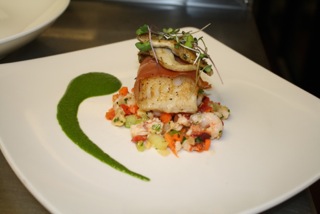
Chef Mitchell Kaldrovich’s Serrano-Wrapped Roasted Red Fish
1 Cup Local Shrimp, Quickly Blanched (20 sec. in Salty water then iced)
½ Cup Smoked Bay Scallops
½ Cup Celery, dice
½ Cup Carrot, dice
½ Cup Cucumber, Seedless, dice
2 Tbs. Fine Chopped Chives, Tarragon & Parsley
Juice of 2 Fresh Lemons
5 Tbs. Fruity Extra Virgin Olive Oil
Sea Salt, Pepper, Cumin Powder, Coriander
1.5 Cup Fresh Ouster Mushrooms, Clean & w. bottom removed
1 Garlic Clove
Chopped Italian Parsley
Prepping the Salpicon:
Salpicon is a Traditional South-American cold “chopped salad” usually made with leftovers such as Roasted Chicken or grilled fish. You can add any kind of vegetables as well.
Blanch, chilled and strain the shrimps. Sliced the lobster meat into little bites. Mix all seafood in a bowl. Add the raw diced vegetables, season with salt & pepper and lightly sprinkle with cumin & coriander.
Add the herbs and the lemon juice and olive oil. Keep refrigerated.
Red Fish:
Ask your fish Market to skin your red fish. Red Fish have a great taste and are fun to work with.
In a very hot cast iron skillet, add some canola oil and roast the fish wrapped in Serrano, then lower the heat to medium. Cook for 3-5 minutes or until it starts to get golden brown- then flip the brown side up and transfer the pan to a preheated oven at 350F and cook for about 8-10 more minutes. The Serrano Ham should be crispy but not burned and the fish should be just cooked thru. Reserve the fish in a warm place.
Oyster Mushrooms:
Using your finger, tear the mushrooms into smaller stripes. Make sure there is no dirt or leaves.
In another very hot sautéed pan, quickly add some olive oil or canola and cook the whole garlic clove for 10 seconds, then add the mushrooms and cook for 3-4 minutes or golden brown, season with salt, pepper and chopped parsley.
Salsa Verde:
1 Cup Cilantro Leaves / 3 tbs. Chopped Chives / ½ Cup Parsley Leaves / 4 Sprigs of fresh Tarragon
2 Tbs. of Capers
3 Tbs Champagne Vinegar
Juice of 1 Lemon
Juice and Zest of 1 Lime
½ Cup Olive Oil
Blend all ingredients into the blender until a smooth puree. Season with salt and pepper. Chill
“I don’t really use recipes,” says William Howe, chef on the traditional Maine windjammer Angelique as he peels potatoes for the day’s fish chowder lunch. “I go by technique.”
Sailing aboard a Maine windjammer is as much about the food as it is about the cruising, but the Angelique is one of the few, if not the only, windjammer with a chef, rather than a cook. Howe trained and instructed at Le Cordon Bleu’s New Hampshire campus and has worked in restaurant kitchens throughout New England, most recently at Portland’s Petite Jacqueline.
I joined Howe in the small galley of the Angelique, doing my best to stay out of the way of his cooking dance with Sarah, the baker. They’ve perfected a routine of half-pirouette, arabesque, and hip-hop moves as they slide by each other in the narrow space, avoiding the hot oven, cooling trays, chef’s knives, and preparations underway.They’ve also created an ingenious oven-mitt system, where each keeps at least one mitt attached via a draw cord at the waist.
Today’s lunch is fish chowder, accompanied by biscuits, fresh greens, and jam-filled cookies. While Howe makes the chowder, Sarah is making the biscuits and cookies, and someone below decks was composing the salad and dressing (the latter brought to Howe for a tasting before serving: “a little more vanilla,” he directed).
Note: See pics from my day aboard the Angelique here.
William Howe’s Angelique Fish Chowder
Serves 4
Ingredients
4 medium potatoes, cut into bite-size pieces (Howe recommends Yukon Gold or Red Bliss).
2 yellow onions or 1 Spanish onion chopped medium
1 stalk celery chopped small
½ pound hickory smoked bacon chopped into quart-inch pieces
½ clove garlic smashed then mashed with a knife
2 quarts fish stock (Make from scratch by simmering fish bones in water or make from fish base using water from cooked potatoes)
1 cup milk (preferably warmed)
1 cup heavy cream (preferably warmed)
1 bay leaf
1 teaspoon each: sage, dill, celery seed
dash of red pepper
salt and pepper to taste
all-purpose flour (You need enough to soak up all the fat and have a dry sand-texture mixture. Amount varies depending upon how much moisture the flour has absorbed from the air that day. Start with 1.5 cups and go from there)
1 pound fish (haddock, cod, pollock, hake), cut into bite-size pieces
Preparation
1. Fill a large pot three-quarters full with cold water, salt heavily (this is crucial for flavor), add potatoes, then bring to a boil. Cook to al dente: not raw / not cooked. Pull out of water and let continue to steam in covered pot.
2. While potatoes cook, render bacon in a little bit of fat. Sweat it: goal is to caramelize the bacon until it’s crispy and dark, but don’t let it burn.
3. Add onions and celery to the bacon and let simmer.
4. Add mashed garlic to onion/celery/bacon mix, and simmer, stirring occasionally, until onion is translucent..
5. Remove pot with onion/celery/bacon mix from heat, and then sprinkle flour into it gradually, mixing it thoroughly after each sprinkle to avoid globs. It will thicken. Go slowly. You want it to be almost dry with a sand-like texture.
6. Add the fish stock (and go ahead, hit it with a splash of white wine, too). You want a pancake batter texture.
7. Return pot to stove, and bring it to a bubble to activate the gluten and thicken it. Be careful not to boil it.
8. Add warmed milk and cream in stages. It’s easier to thin a chowder than to thicken it. Bring it to a bubble (not boil) again.
9. Taste and season with salt and pepper. Be careful, because the potatoes have been cooked in heavily salted water. It’s a balancing act.
10. Add bay leaf, sage, dill, celery seed, and red pepper and potatoes and bring to a bubble again.
11. Add fish and bring to a bubble, then serve with biscuits and a salad.
Are you familiar with Moxie, official soft drink of Maine? Jim Baumer and Frank Anicetti want to make sure you know about a beverage that once was more popular than either Coca-Cola or Pepsi. Baumer is the auther of Moxie: Maine in a Bottle (Down East Books, 2012), and Anicetti is the wizard behind the annual Moxie Festival, held in July, in Lisbon Falls (July 13-16, 2012).
Moxie was created by Dr. Augustin Thompson, a native of Union, Maine. On his patent registration in 1885, he described Moxie as “a liquid preparation charged with soda for the cure of paralysis, softening of the brain, and mental imbecility.”
Author Jim Baumer grew up in Lisbon Falls, which is, in his words, “the epicenter of the Moxie universe.” In Moxie: Maine in a Bottle he explains the soft drink’s history and cult-like following, and delves into its relationship with Lisbon Falls and Maine.
That relationship is due to Frank Anicetti, the Moxie Man, proprietor of Kennebec Fruit Company store, a.k.a. Kennebec’s, in Lisbon Falls. The dedicated Moxie fan and collector of Moxie memorabilia is credited with starting the annual Moxie Festival, which now draws tens of thousands of visitors to the small town on the Androscoggin River between Lewiston and Brunswick. The festival had its roots in book signings in 1982 and 1983 with Frank N. Potter, whose 1981 book The Moxie Mystique was the soft drink’s bible. Crowds of Moxie fans came, and the local chamber took over in 1984. Since then, the classic small town wind-ding has evolved into a three-day whoop-di-do, without losing its soul.
The jam-packed schedule includes games and family fun nights, breakfasts and suppers, dance recitals and concerts, pony rides and foot races, fireman’s muster and fireworks, but the biggies are the Moxie Festival Parade, Moxie Recipe Contest Judging, Moxie Chug-n-Challenge, Moxie Car Show, and the Chief Worumbo Androscoggin River Race. Baumer will be signing his book on Saturday in front of Kennebec’s, just after the parade.
Looks like a perfect weekend to find out if you’ve got it, Moxie, that is.
In Lobster! Brooke Dojny shares lobster recipes, lore, terminology, and more.
Cookbook author Brooke Dojny’s done it again. Lobster! 55 Fresh & Simple Recipes for Everyday Eating (Storey, $14.95) is a summer must-have for anyone who enjoys Maine’s tasty crustacean. Dojny includes not only lobster recipes but also lobster terminology, basics, and other useful info.
Dojny, who lives on the Blue Hill Peninsula, knows Maine and knows lobster. She draws not only from her own well of recipes but also from the knowledge and experiences of others, from lobstermen to chefs.
The book’s introduction covers all the basics, from catching and lobster lingo (cars, hens, keepers, rippers, shedders, smellers, etc) to cooking basics. After that, recipes are broken down into chapters for hors d’oeuvres; salads; chowders and stews, mains; rolls, tacos, pizzas, and sandwiches, sides, and desserts.
The book is salted with photos and notes, quotes, trivia, and quizzes, making it not only a good resource but also a fun read. And if you’re squeamish about killing lobsters, most recipes allow for store-bought lobster meat, saving you that experience.
This lovely creamy mousse is an excellent way to turn a bit of leftover cooked lobster into a simple and delicious appetizer. “Potted” is an old British culinary term for a method of preserving perishable food (especially seafood) in melted butter. Although these days we have refrigerators and freezers for that purpose, I still like the old name.
3/4 cup roughly chopped cooked lobster meat (3–4 ounces) (see Note)
1/3 cup whipped cream cheese
4 tablespoons cold butter, cut into small chunks, plus 1 tablespoon, melted
2 teaspoons grated lemon zest
2 teaspoons lemon juice
1/2 teaspoon liquid hot pepper sauce
3 tablespoons snipped fresh chives, plus spears for garnish
Salt
Crackers, for serving
Makes 3/4 cup, about 6 -appetizer servings
1. Pulse the lobster meat in a food processor until finely chopped and remove to a bowl; do not wash the processor.
2. Combine the cream cheese, cold butter, lemon zest and juice, and hot pepper sauce in the food processor and pulse until well blended. Add the lobster and pulse until quite smooth. Transfer to a bowl, stir in the snipped chives, and season with salt to taste.
3. Scrape the mixture into a ramekin and pour a thin layer of melted butter over to seal.
4. Refrigerate for at least 4 hours to allow the flavors to blend. (The ramekin can be filled up to 2 days ahead.)
5. Remove the ramekin from the refrigerator about 2 hours before serving. Garnish the mousse with chives and spread it on crackers to serve.
Note: Cook one 1-pound hard-shell lobster and remove the meat (see chart, page 15) or buy picked-out meat.
• Seashell Lobster Pasta Salad with Lemon-Dill Cream
Seashell pasta is the perfect shape for a lobster pasta salad. Not only are the shells reminiscent of the ocean, but they’re also ideal for catching plenty of the lemon-dill cream. Add a basket of seeded French bread and serve Mocha–Chocolate Chip Shortbread Cookies (page 130) and bunches of green grapes for dessert.
Cream
3/4 cup mayonnaise
1 tablespoon Dijon mustard
2 teaspoons grated lemon zest
1 tablespoon lemon juice
Salt and freshly ground black pepper
11/2 tablespoons chopped fresh dill
Salad and Garnishes
10 ounces small or medium pasta shells
1 small yellow bell pepper, seeded and chopped
3/4 cup thinly sliced celery
1/2 cup chopped red onion
11/2 cups chopped cooked lobster meat (7–8 ounces) (see Note)
Salt and freshly ground black pepper
About 6 lettuce leaves for lining platter
1 tomato, cut into wedges
4 thin lemon slices
Fresh dill sprigs for garnish
4 servings
1. Bring a large pot of salted water to a boil for the pasta.
2. To make the lemon-dill cream, whisk the mayonnaise with the mustard, lemon zest, and lemon juice in a small bowl. Season with salt and pepper to taste. Stir in the dill. (Can be prepared up to 24 hours ahead.)
3. Cook the pasta in the boiling water until al dente, about 10 minutes. Drain into a colander, rinse under cold water, and drain well.
4. Toss the cooked pasta with the bell pepper, celery, onion, and lobster meat. Drizzle most of the dressing over the pasta and toss until well blended. Season with salt and pepper to taste. If the salad is dry, add the remaining dressing. Refrigerate for at least 1 hour. (Can be prepared up to 12 hours ahead.)
5. To serve, line a platter with lettuce, spoon the salad into the center, and garnish with the tomato, lemon slices, and dill sprigs.
Note: Cook one 1½-pound hard-shell lobster or two 1-pound soft-shells and remove the meat (see chart, page 15) or purchase picked-out meat.
Western Maine’s Largest Yard Sale and the new Flying Disc Golf Course and bungee trampoline are just a few reasons to visit Sunday River, in Bethel, Maine, when it opens its mountain park for the summer season this weekend.
• The all-day yard sale on Saturday, June 30, will take place in the parking lot adjacent to South Ridge, Sunday River’s main base lodge. Approximately 50 large booths will overflow with gazillions of from-my-attic-to-your-basement finds.
• The Flying Disc Golf Course is set along the trails and in the woods near South Ridge. The sport is similar to regular golf, in that players want to hit all targets in the fewest number of swings, or tosses, but that’s where the similarity ends. In flying disc golf, participants toss a disc at a target.
• Guests trying the Bungee Trampoline are strapped into a harness attached to bungee cords, which will allow them to reach new heights and get creative with tricks.
Throughout the weekend, the resort will be offering lift-assisted mountain biking, zipline tours and twin zips, geocache adventures, scenic lift rides, wildlife tours, and much more. Pricing for each activity varies, but new this summer is and “Adventure Package” allowing all-day unlimited access to scenic lift rides, Twin Zips, the bungee trampoline, and the flying disc golf course for $25 ($22 for kids) .Lodging packages for opening weekend start at $49 per person, including a day of lift-serviced mountain biking.
Looking ahead: The Maine State Championship Downhill for professional and amateur mountain bikers is slated at Sunday River on Sunday, July 8.


 In 2008 Frenchman Bay Conservancy purchased 600 acres of land known as the Corea Heath, and that summer, volunteers began cutting trails. Heath is a local word for peatland or bog. And this one is a rare coastal plateau bog, distinguished because it rises above the surrounding landscape.